
Launching a Group Program? How to Build True Community
If you're a coach considering a group program, you need to know how to build a community. Building real community isn't about luck or personality — it's about understanding what actually creates belonging, and developing the skills to sustain it. Most of us were never taught how to build community in any deliberate way, and the gap that leaves is real: connection that feels hollow, groups that don't stick, and a low-grade hunger for something more solid.
We break down the difference between cultivation — showing up consistently, being willing to go first, creating the conditions for belonging — and the specific skills that make community work: trust signaling, behavioral integrity, active listening, somatic awareness, and recognizing the inner critic narratives that quietly keep people isolated.
And for coaches, this isn't just personally relevant. It's professionally essential. The coaches who know how to build community from the inside out bring something qualitatively different to their clients — because you can't hold space for what you haven't lived.
If you've been thinking about how to build community that actually feels like something — this episode is a place to start.
When Can You Call Yourself a Coach?
We’ve absorbed a quiet rule in the coaching industry: you’re not legitimate until your calendar is packed. If you’re not fully booked, you’re still “trying.” Still “building.” Still “not quite there.”
Let’s challenge that.
A fully booked client roster is a business metric — not a measure of your identity. When we tie our legitimacy to calendar saturation, we hand our confidence to algorithms, economic cycles, and comparison. And that’s a fragile place to build from.
In this episode, we unpack what actually makes someone a coach: commitment to craft, ethical standards, reflective practice, and skill development. We separate coaching skill from marketing outcomes, and we explore why claiming your professional identity early accelerates growth instead of inflating ego.
If you’ve been wondering when you can call yourself a coach, or feeling pressure to prove yourself through volume, this conversation will reset your internal barometer.
Stop the Comparison Spiral of Comparing Yourself to Other Coaches
Ever catch yourself scrolling and wondering, Why am I not there yet? You’re not alone. In this episode of the Craft of Coaching, we’re naming the comparison spiral that so many coaches fall into—especially in a world where highlight reels dominate.
We break down exactly how comparison derails your intuition, your business decisions, and your confidence—and what experienced coaches do differently to stop it in its tracks. You’ll hear practical, grounded strategies for staying focused on your path, building your coaching business with integrity, and reconnecting with your own metrics for success.
If you’ve ever felt like everyone else is ahead of you, or like you need to be louder or flashier to “make it,” this episode will rewire the way you see your coaching journey.
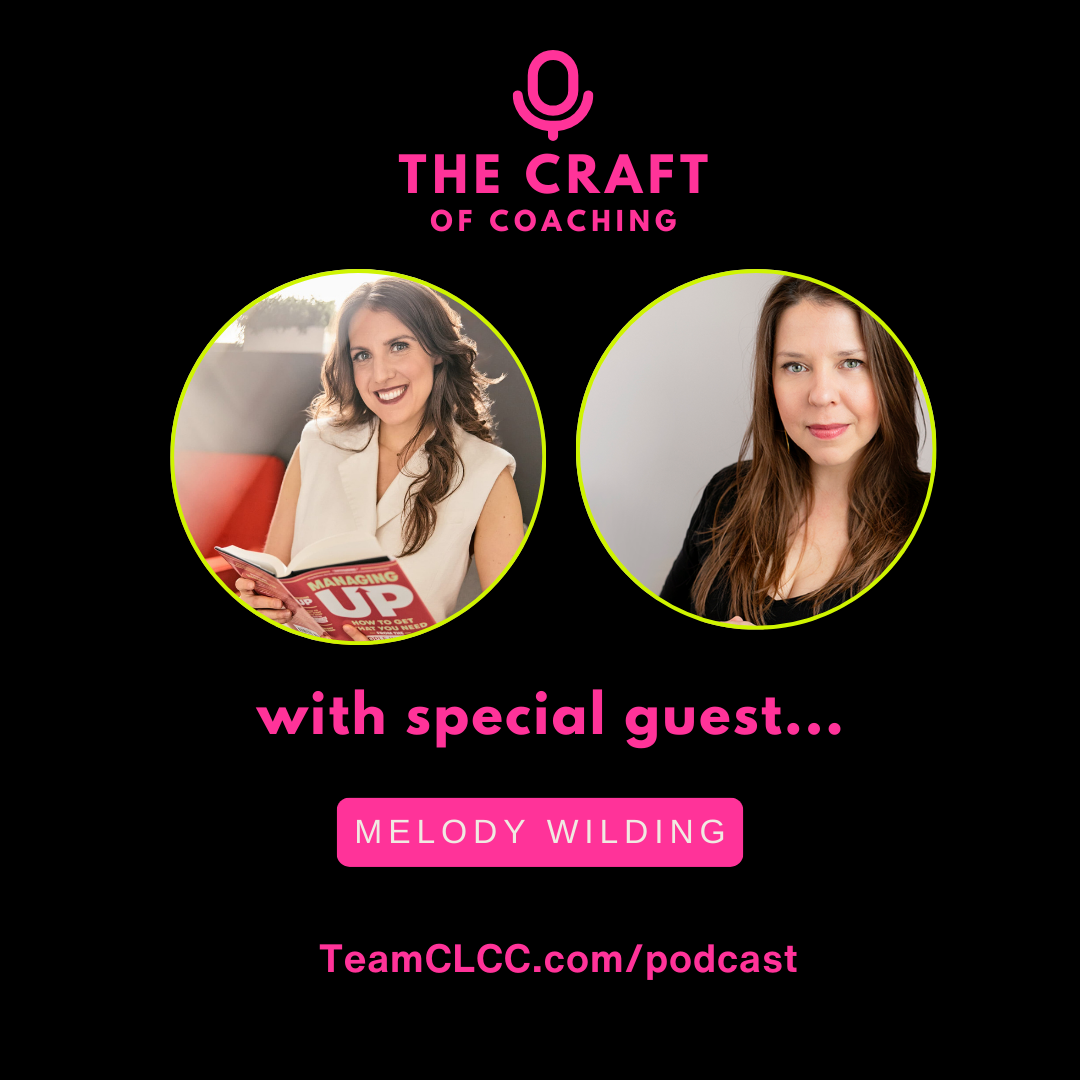
Coaching Clients through Workplace Conflict: Managing Up with Melody Wilding
When a client says "my manager is the problem," what do you do with that? In this episode, we're joined by Melody Wilding — executive coach, speaker, and author of Managing Up — to talk about one of the most common and least discussed challenges in coaching: helping clients navigate difficult relationships with the people above them at work.
Melody breaks down why coaching clients through workplace conflict starts not with confrontation, but with two deceptively simple conversations: alignment and communication styles. We dig into a real client story — a Chief People Officer who went from being told she might be "incompetent or over her head" to earning a six-figure bonus — and what actually shifted. We also talk about how coaches can use proprietary assessments to demonstrate client progress to organizational stakeholders, and how Melody built a speaking business from zero, starting with free talks and a clear ask.
Whether you're working with clients in corporate environments or thinking about expanding into organizational coaching yourself, this episode is full of the kind of concrete, actionable strategy that makes the work better.